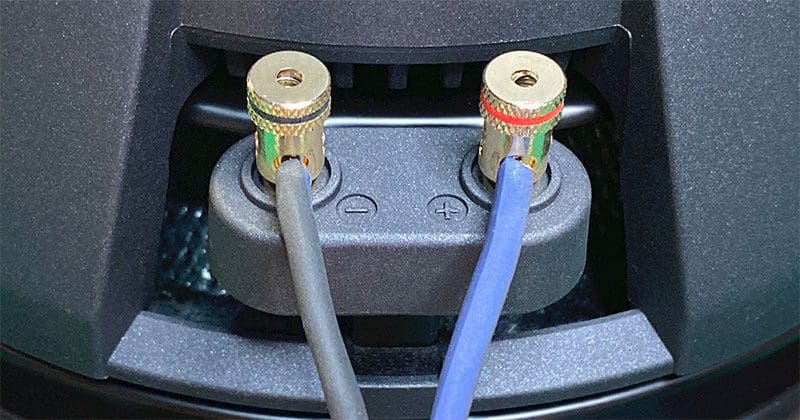
A few weeks ago, we were browsing a few car audio related Facebook groups and Reddit subreddits. We saw the same question come up time after time: “I have two dual 2-ohm voice coil subs; how do I show the amp a 1-ohm load to make max power?” It wasn’t just once or twice that this question was asked – we saw it and versions of it at least a dozen times in less than an hour of browsing. Clearly, this is a topic that consumers struggle to understand. Subwoofer wiring configuration is crucial information if you’re shopping for an amplifier to mate to an existing set of subwoofers, or vice-versa.
Subwoofer Voice Coil Impedances
We’ve talked about single- and dual-voice coil designs in the past. In essence, they exist to provide the Product Specialist designing your car audio system with different wiring options so that they can maximize the performance of your subwoofer amplifier.
We’ll be clear: A single voice coil subwoofer isn’t “better” than a dual voice coil sub, or vice versa. The only benefit of a DVC sub is that the coils can be wired in series, in parallel, or each can be fed directly to an amplifier channel. There are benefits in terms of installation flexibility, but the number of connections to the voice coil doesn’t improve the driver’s performance or sound quality.
In subwoofers available from professional mobile enhancement retailers, you’ll typically see either single 2-ohm or single 4-ohm drivers and dual 2-ohm or dual 4-ohm offerings. There are some unique offerings as well. The JL Audio W7AE drivers have a single 3-ohm coil, so three drivers can be wired together to present a 1-ohm load to an amp. Audiotec-Fischer has some quad 3-ohm-coil woofers designed to extract maximum power from its line of non-bridgeable amplifiers.
When you get into some competition-level subwoofer products, you may see some dual 1-ohm coil configurations. If we think long and hard, we seem to recall hearing about a quad 0.7-ohm coil competition-level subwoofer. Nevertheless, there are a lot of options available.
Picking the Final Load Impedance
When it comes to wiring subwoofers to an amplifier, your installer has a few wiring options: parallel, series and series-parallel. The voice coils of a single dual-voice-coil woofer can also be wired in series or parallel. The goal of the options is to present the amplifier with a net impedance that allows it to make the best use of the available power.
You see, most subwoofer amplifiers produce more power as the load impedance drops. If we look at an amp like the ARC Audio X2-1100.1, it’s rated to produce 350 watts into a 4-ohm load, 600 watts when connected to a 2-ohm load and 1,100 watts when the subwoofers are wired to present a 1-ohm load. If you’ve purchased this amp, it only makes sense to present it with a 1-ohm load so that you get the most power available for your investment.
Here’s a small aside about amplifiers: Many subwoofer amps don’t make more power into lower impedances yet are still designed and listed as capable of running these loads. For example, the Rockford Fosgate T1500-1bdCP is rated to produce 1,000 watts when connected to a 4-ohm load, then 1,500 watts when wired to a 2- or 1-ohm load. The same goes for the Hertz Mille Power 1. It produces 600 watts into a 4-ohm load and 1,000 watts when connected to a 2-or 1-ohm configuration.
We highly recommend wiring these amplifiers to 2 ohms. The higher impedance will improve the amplifier’s efficiency, allowing you to deliver more power to your subwoofers with less draw on your electrical system.
Subwoofer Wiring Options
Let’s start by looking at wiring pairs of subwoofers to an amplifier. The simplest would be two 4-ohm single-voice-coil subwoofers wired in parallel. Two identical loads wired in parallel present a single load that is half of the single-load impedance. In this case, two 4-ohm subwoofers present the amplifier with a net 2-ohm load.
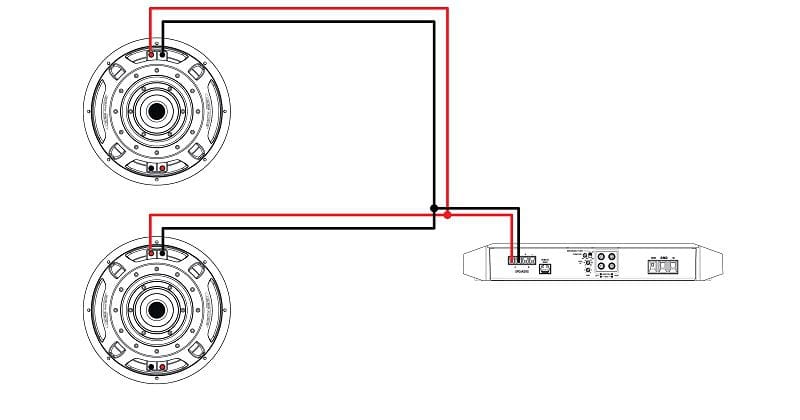
If you have an amplifier like the Rockford Fosgate T1500-1bdCP that we’ve used in the drawings that include a pair of terminals, you can wire one sub to each terminal. The two positive terminals are wired together inside the amp, so are the negative terminals. Having two sets of terminals can help keep the wiring neat and tidy in installations like this.
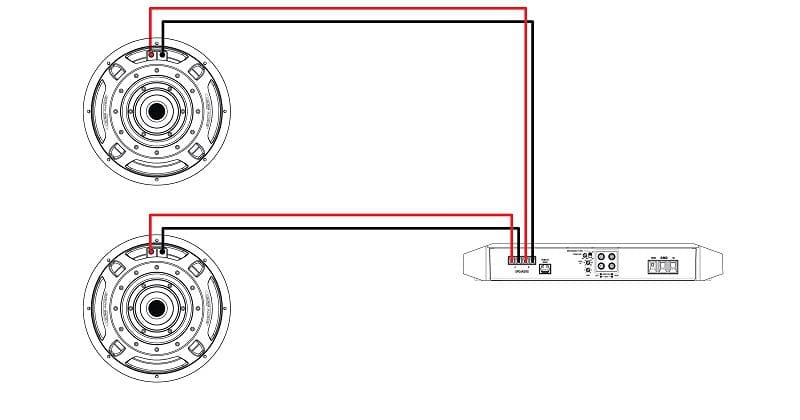
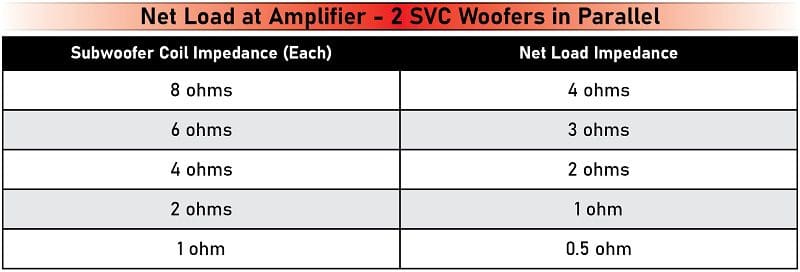
In both of the above scenarios, the load the amp “sees” is half of the impedance of one woofer. The chart below shows you the net load for common subwoofer options.
A less common configuration is to use low-impedance drivers and wire the subwoofers in series. Series wiring results in the sum of each voice coil impedance being added. For a pair of 4-ohm woofers wired in parallel, the amp would “see” an 8-ohm load.
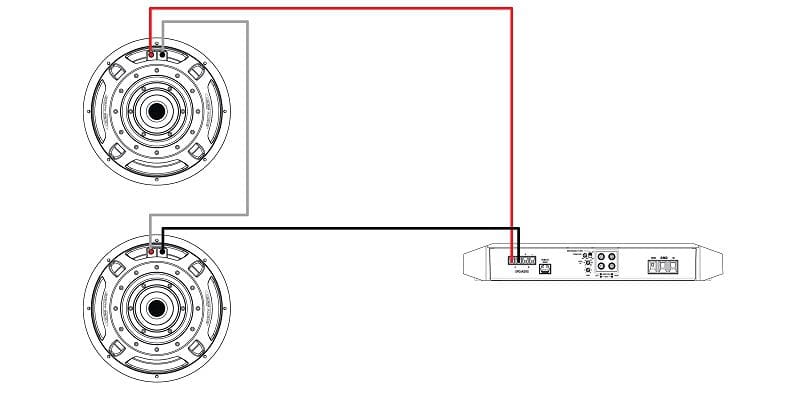
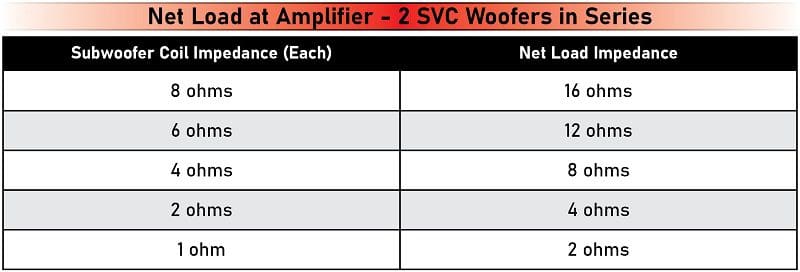
A quick note about wiring subwoofer voice coils in series: Sometimes it’s necessary when multiple drivers are involved. With that said, there is a small drawback. The inductance of the individual voice coils adds and can result in a very reactive load for the amplifier. This configuration can cause instability in lower-quality amplifiers and reduce mid-bass performance from the system. The latter can result in difficulty getting the sound from the subwoofers to blend with the midbass woofers so that the bass appears to be coming from the front of the vehicle. It’s more important to present the amplifier with the correct load, but keep this in mind.
Dual Voice Coil Subwoofer Wiring
Let’s start by looking at the options to wire a single DVC subwoofer to an amplifier. We have the choice of wiring the individual coils in series or in parallel.
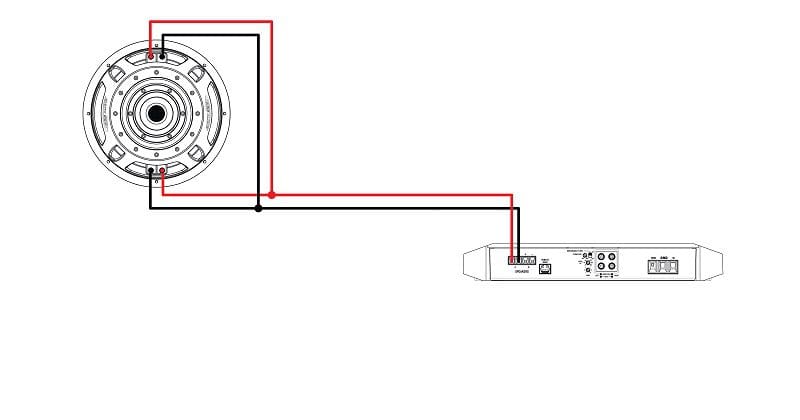
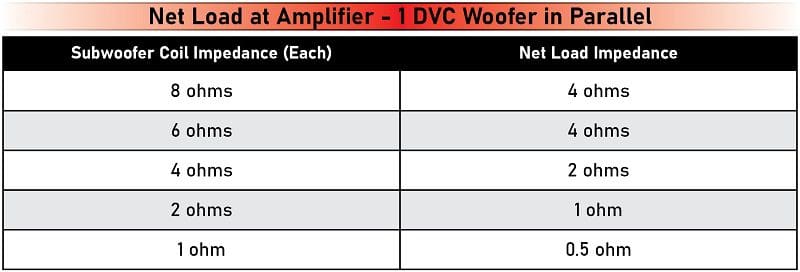
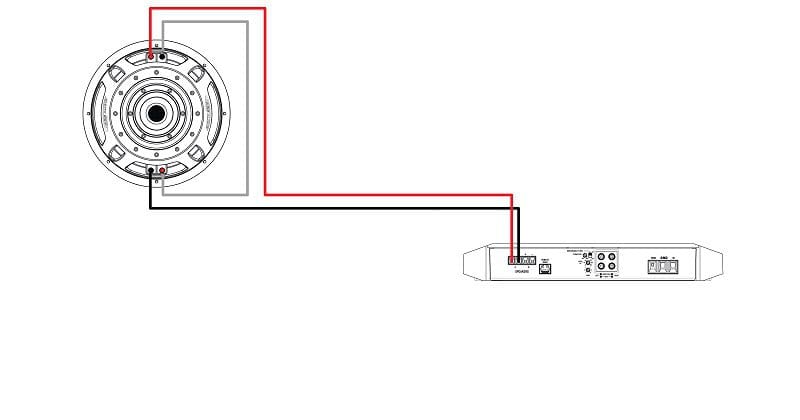
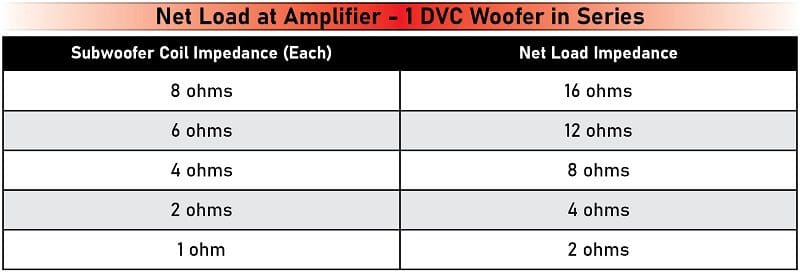
Wiring multiple dual voice coil subwoofers to a single amplifier presents a whole gamut of options. For example, we can wire all the coils in series, all in parallel, or mix them in a combination of series and parallel. It’s crucial to note that each DVC subwoofer in the system needs to be wired the same way. If one has its coils wired in series, all of them need to be wired in series. The same goes for wiring them in parallel. We’ll explain with a few examples.
Let’s start with an example of two dual-voice coil subwoofers with all four coils wired in parallel. This is a common configuration for dual 4-ohm subs wired to an amplifier optimized to make power into a 1-ohm load.
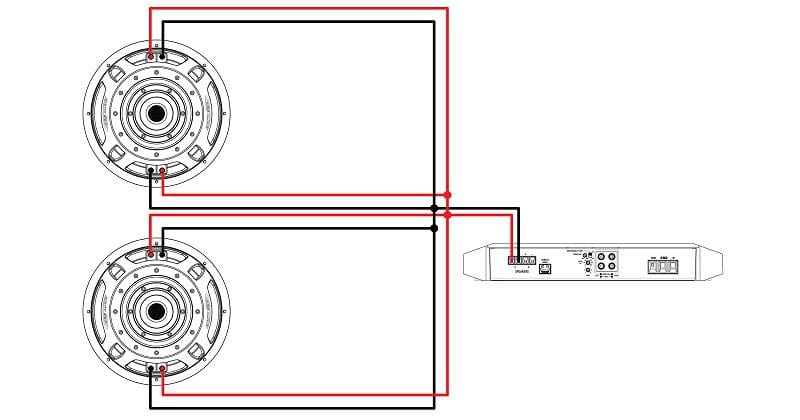
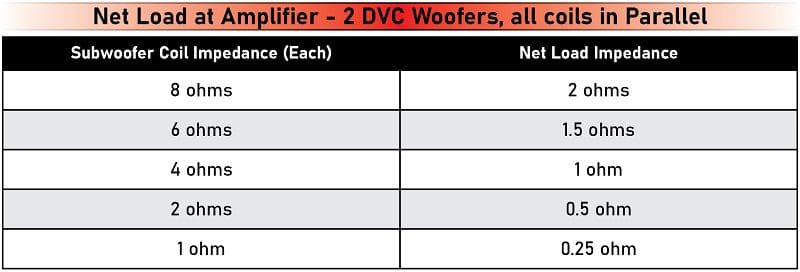
In this example, the load seen by the amplifier is one-quarter the value of each coil. So, for 4-ohm voice coils, the amp will see a 1-ohm load.
It is also possible to wire all four voice coils in series. This might be an option for drivers with very low impedance coils, like a dual 1-ohm design. Just as with our single voice coil subwoofers, wiring in series adds the impedance of each coil. This is a very unlikely configuration in a car audio system.
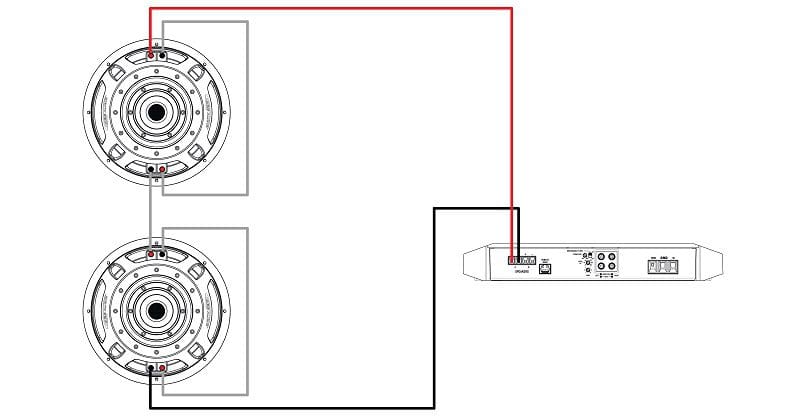
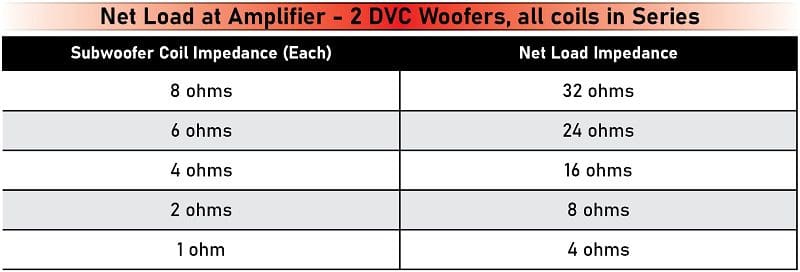
Now that you’ve had a taste of how subwoofers and their voice coils can be wired in series or parallel, let’s combine both to create what is easily the most common configuration: two dual-voice-coil subwoofers with their coils wired in series, and both drivers wired in parallel with each other. In this configuration, the amplifier “sees” a load that’s equivalent to the impedance of a single coil.
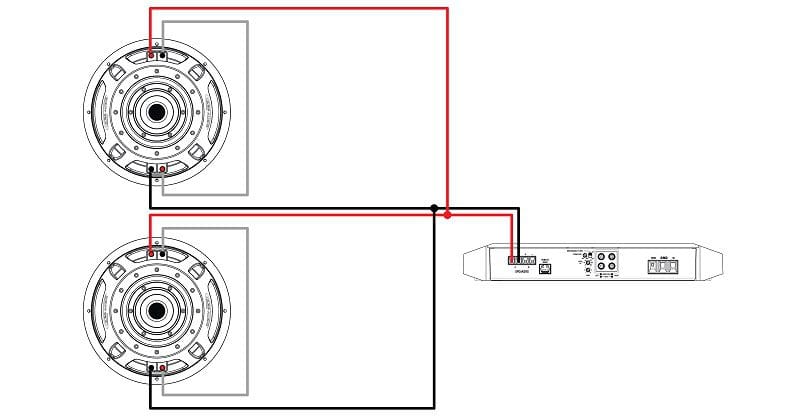
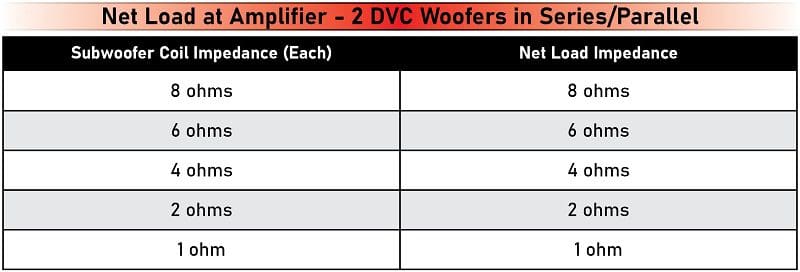
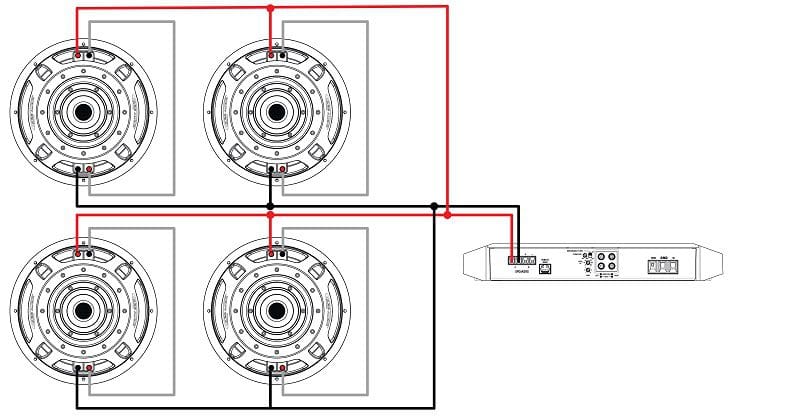
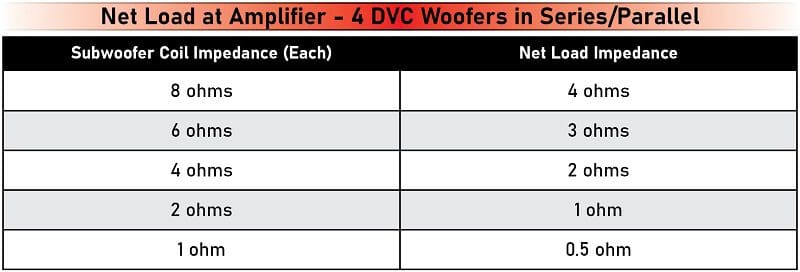
You can wire more than just two subwoofers together in series, parallel and series-parallel wiring. Four, eight or even 16 subwoofers can be driven from a single monoblock amplifier, so long as the net impedance is correct.
Two Amplifiers on a Single Subwoofer
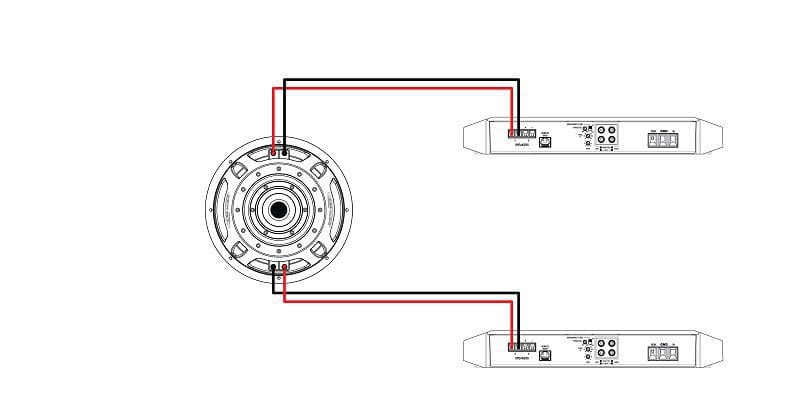
If you have a dual voice coil subwoofer and would like your installer to use two amplifiers or all four channels of a four-channel amplifier, the electrical connections are quite easy. In either scenario, your installer will need to use a digital scope with a voltage readout or a high-quality digital multimeter to ensure that each coil is receiving exactly the same voltage. In addition, the subwoofer will need to be chosen such that each coil’s impedance maximizes the power available from the amplifier.
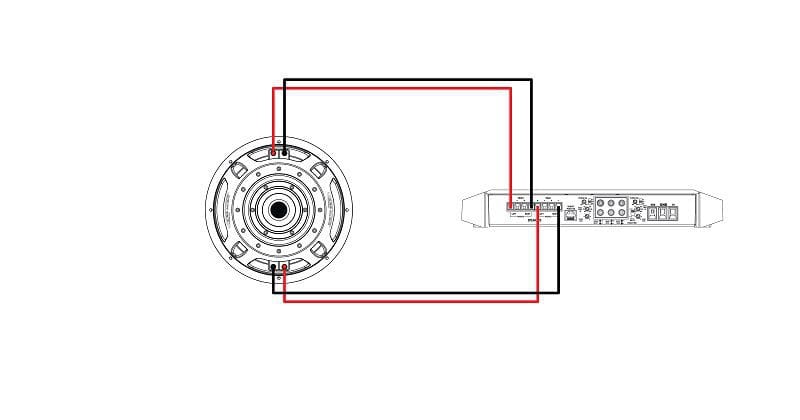
If you want to use a four-channel amp, then the connections to the subwoofer are the same. One coil will be wired to channels one and two in a bridged configuration and the other coil to channels three and four when bridged. In almost all cases, a four-channel amp will want each pair of bridged channels to see a 4-ohm load, so a subwoofer with dual 4-ohm voice coils is the only choice.
A Few Rules To Keep in Mind
There are a few guidelines to keep in mind as you and the Product Specialist you’re working with discuss your system design. First, all subwoofers connected to an amplifier should have the same impedance. For example, you can’t use a dual 2-ohm and a dual 4-ohm sub on the same amplifier.
The second rule is that all the voice coils of a DVC or quad-coil subwoofer must be used. If you need a 2-ohm load but have a dual 2-ohm subwoofer, you need to change the amp or the sub in the system design. Using one voice coil changes all the parameters of the woofer and doesn’t promise good sound or reliability.
Last, all the subwoofers should be installed in enclosures with the same air volume. We once heard a “story” where a vehicle owner told us one 12-inch sub was in a small enclosure for fast bass, and the other was in a large enclosure so it would produce deep bass. No. Just No. Please don’t do this. They all need to have the same amount of air behind them in the enclosure to deliver predictable results.
Oh, I suppose we should mention that mixing different size woofers or different models of woofers in one system is also less than ideal. That whole “fast” and “deep” stuff is silly. If you want to use some smaller woofers for midbass, that makes complete sense. This is popular in system applications where high-efficiency PA-style speakers are being used. With that said, very few car audio subwoofers are designed to play up to 250 or 300 Hz without some significant amounts of cone resonance distortion.
Anyway, please don’t mix and match different size subwoofers in a single system. We recommend saving your money and having the subwoofer system designed and installed properly. Your local specialty mobile enhancement retailer can help you choose the best amplifier and subwoofer combination, then design an enclosure that will make the best use of the space in your vehicle, so your stereo system sounds amazing.

