
Music sounds less clear in a moving vehicle because road and vehicle noise compete with the same frequencies your music uses, which causes detail to disappear even on high-quality audio systems. That loss of clarity becomes obvious once you understand how noise interferes with what you hear.
Driving environments are far louder than most people realize. Tire noise, wind, engine harmonics and vibration all add constant sound that your brain must process alongside the music. That competition for attention is where musical detail begins to fade.
Why Music Loses Clarity While Driving
Music loses clarity because background noise interferes with how your brain separates and prioritizes sound. Your hearing system naturally focuses on louder and more persistent signals first, which pushes quieter musical elements into the background.
When road noise is present, your brain works harder to filter out unwanted sound. The result is not just lower perceived volume but missing information. Instruments blur together, vocals lose intelligibility and the emotional impact of the recording is reduced.
What Auditory Masking Means in Simple Terms

Auditory masking happens when one sound makes another harder to hear, even though both are present at the same time. This is a normal function of human hearing, not a flaw in your audio system.
A familiar example is trying to follow a conversation in a crowded restaurant. The voice is still there, but surrounding noise makes it difficult to focus. Inside a vehicle, road noise plays the role of the crowd while music becomes the conversation you are trying to hear clearly.
Why Midrange Noise Causes the Most Damage
Midrange noise causes the most damage because it overlaps directly with the frequencies used by vocals and most instruments. This overlap is why clarity suffers even when speakers and amplifiers are capable of excellent performance.
Common sources of midrange noise inside a vehicle include:
- Tire noise transmitted through the floor and wheel wells
- Wind turbulence around mirrors, doors and rooflines
- Engine and drivetrain harmonics carried through the chassis
When these sounds overlap with music, voices lose clarity and instruments lose definition. Lyrics become harder to understand and musical lines that should sound distinct begin to smear together.
Why Low-Level Musical Details Disappear First
Low-level musical details disappear first because they sit closest to the noise floor inside the vehicle. These quiet elements are essential to realism but are easily covered up by constant background sound.
Details most affected by masking include:
- Background harmonies and supporting vocals
- Reverberation and room ambience
- Fine texture in strings, cymbals and acoustic instruments
As noise fills the cabin, these cues vanish before louder sounds are affected. Turning the volume up does not fully recover them because the noise increases along with the music.
How Noise Reduces Dynamics and Depth
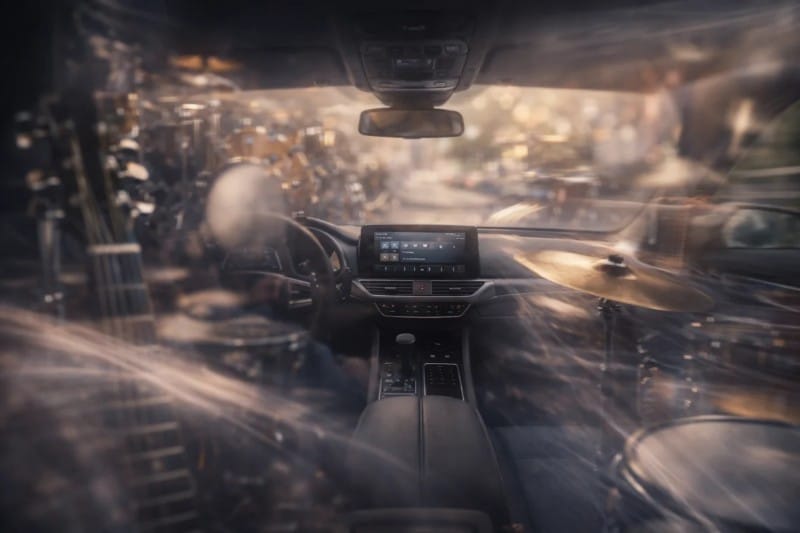
Noise reduces dynamics by raising the baseline level of sound your ears must process. Quiet passages lose contrast and loud moments feel less impactful, which flattens the emotional range of the music.
Depth is also reduced because spatial cues rely on subtle differences in timing and level. When those cues are masked, instruments that should sound layered and three-dimensional collapse into a shallow presentation with little sense of space.
Why Speaker Quality Alone Is Not the Solution
Speaker quality alone cannot solve auditory masking because the problem exists before sound reaches your ears. Even the highest-performing speakers cannot overcome constant background noise competing for the same frequencies.
This is why many drivers upgrade speakers and still feel underwhelmed. The equipment may be capable of excellent performance, but the listening environment prevents that performance from being heard.
Why Reducing Noise Improves Every Audio System
Reducing noise improves every audio system by removing the obstacle that hides musical detail. When the cabin is quieter, vocals regain clarity, instruments separate more naturally and low-level details return.
Music sounds fuller and more engaging at lower volumes, and listening fatigue is reduced. Instead of forcing the system louder, the system simply sounds more realistic and balanced.
What This Means for Your Listening Experience
If music in your vehicle sounds flat, harsh or lacking in detail, noise is likely the limiting factor. Many drivers do not realize what they are missing because the loss happens gradually and becomes familiar.
Understanding how noise masks musical detail explains why addressing the acoustic environment is so important. To learn more about professional noise control solutions and how they can improve your in-car listening experience, visit a qualified retailer near you using the Dealer Locator.

