The category of motorcycle-specific speakers has represented some of the most significant growth in the mobile electronics industry over the last decade. An undisputed leader in this category is Rockford Fosgate. Their amplifiers, speakers, and subwoofers represent impressive performance and amazing value. Launched in 2025, the TMS14-65 6.5-inch speaker kit is designed as a second-generation drop-in replacement for many 2014-2023 Harley-Davidson motorcycles. That said, their Element Ready design makes them ideal for a wide range of powersports applications. Let’s check them out!
Specifications of the Rockford Fosgate TMS14-65
As mentioned, the TMS14-65 speaker kit includes a pair of 6.5-inch coaxial Element Ready speakers and application-specific grilles for Road Glide, Street Glide and Tour-Pak applications. Mounting hardware and a set of spacer rings for Tour-Pak installations are also included.
By the numbers, the TMS14-65 speakers are rated to handle 150 watts of continuous power. They have a nominal impedance of four ohms and a rated sensitivity of 90.6 dB SPL. All specifications are compliant with the ANSI/CTA-2031 standard, so you know there’s no fudging of numbers.

Speaker Design and Technologies
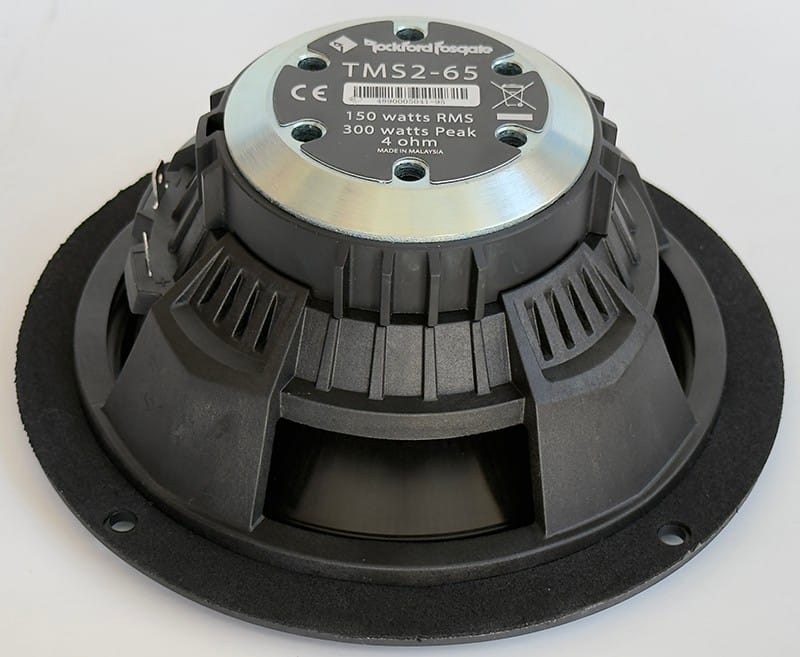
Starting from the basket, we find that the TMS14-65 is built around a custom-tooled polymer basket made from DOMAMID PA66, which is UV-resistant, colorfast, and resistant to chemical degradation. The cone is reinforced with 40% glass fiber for added strength. This amount of glass infill will be hard on the tooling, but ensures reliability for the consumer.
The basket has four thick spokes that connect the base to the mounting flange area. Quick-connect terminals are molded into the basket and sized at 0.25 for the positive and 0.205 for the negative. No venting is visible beneath the spider mounting plateau. Finally, there are four mounting holes that align with Harley-Davidson factory locations. A one-piece foam gasket is pre-installed on the underside of the mounting lip to save your installer a few minutes.
At the bottom of the cone is a machined T-yoke that appears to be zinc-coated for corrosion resistance. There are size large (0.24-inch) vents drilled into the bottom to allow hot air to escape from the voice coil. Inside the T-yoke are dual neodymium magnets to ensure impressive efficiency. Neodymium provides high motor strength in a much smaller size compared to Ferrite magnets, so these will drop directly into your Harley without any modifications.
In terms of soft parts, the focus is the curvilinear-shaped polypropylene woofer cone. The Poly mixture has been reinforced with 10% carbon to improve damping and thermal stability, and to reduce resonance. The cone is attached to the basket using a Santoprene rubber surround that features Rockford Fosgate’s Vertical Attach Surround Technique (VAST) geometry to increase cone area. Put these speakers beside any competing product, and right away you’ll see more cone area. This translates to improved efficiency and better bass response. As they say, bigger is always better.
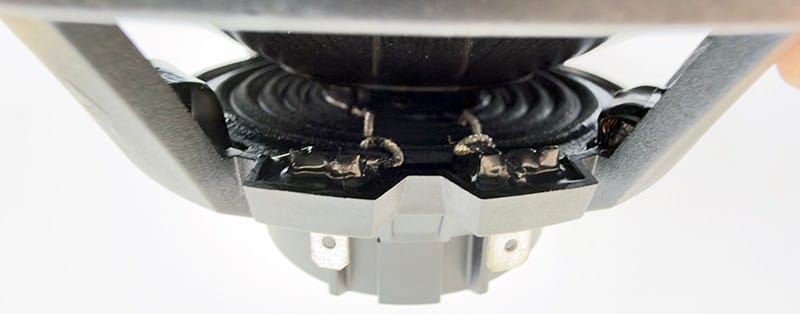
At the base of the cone, Rockford Fosgate implemented a vented Kapton voice coil. They report a diameter of 1.5 inches, larger than in the previous design, which contributes to the increased power handling. A breathable Poly-NOMEX spider provides the woofer’s primary compliance while resisting damage from moisture exposure. The braided tinsel leads are sewn to the spider to ensure reliable, silent operation.
Tweeter Design
At the base of the cone, you can see that there is a secondary flexible joint to the tweeter mount made from the same Santroprene material. This seal ensures that no water can enter the motor assembly, preventing corrosion or damage. The tweeter is a 1-inch dome design with an integrated phase plug in the permanently affixed grille. The tweeter crossover is handled by an integrated 12-dB/Octave network set at 3.5 kHz. Not having an external crossover saves even more time during installation and reduces the possibility of buzzes or rattles from a poorly mounted external network.

Bench Testing
We started the evaluation process by measuring the Thiele-Small parameters of both samples using our Clio measurement hardware. We’d normally use our Smith and Larson Woofer Tester, but it can’t handle drivers with integrated tweeters. With the numbers recorded, we set up the speakers and played a 35-hertz test tone for six hours to break them in. Once done and cooled, we measured the Thiele-Small parameters again to evaluate any potential break-in.
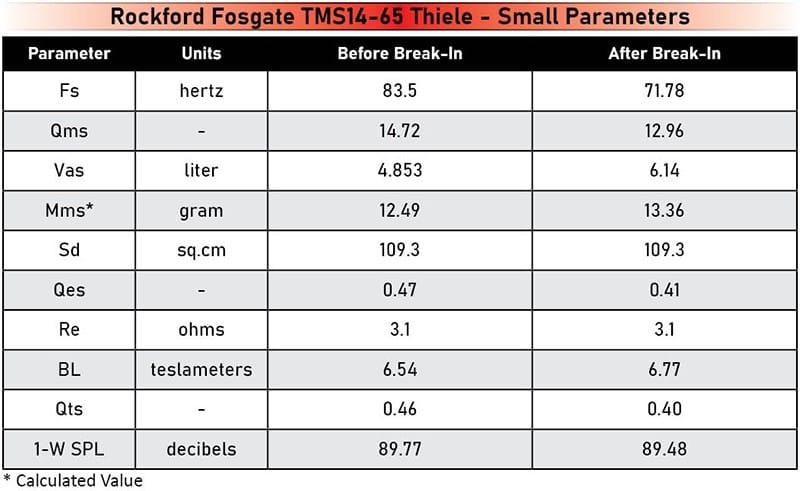
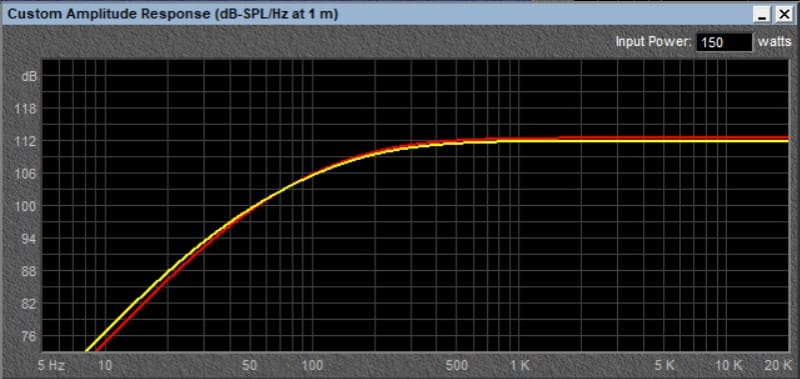
While it looks like the driver’s resonant frequency (Fs) drops a good amount and the compliance (Vas) increases, the effect on the driver’s performance isn’t significant. The graph below shows the driver’s predicted output when new (Red) and after break-in (Yellow). As highlighted in the chart above, the efficiency changed by only 0.29 dB SPL.
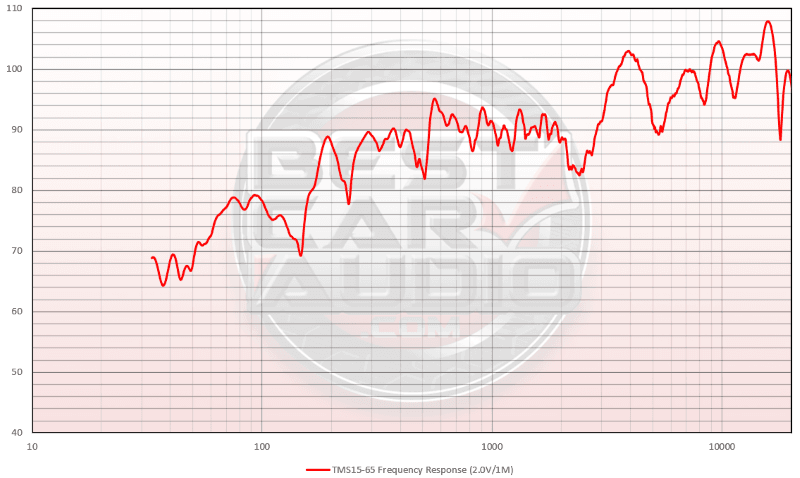
The last step was to take a frequency response measurement. We set the Clio microphone at exactly 1 meter from the mounting surface and calibrated the amp output to deliver 1 Watt into a 4-ohm load. The frequency response sweep you see below shows just how efficient the driver is, producing well over 90 dB SPL of output. With 100 watts, assuming the proper low-frequency filtering was implemented, you’d see over 110 dB SPL from a single driver.
Listening Test
With the driver thoroughly exercised, it was time to set it up for a listen. We mounted the TMS14-65 in one of our 2.6-cubic-foot test enclosures and fed it from a Topping USB DAC connected to a laptop, which in turn drives a high-bias 300-watt-per-channel Class-AB amplifier. When auditioning speakers, we usually listen to a single sample rather than a pair. This makes it easier to pick out tonal and dynamic differences.
As you might tell from the frequency response measurement above, this driver produces a lot of high-frequency information. In a listening room, it’s bright and all sizzle. However, this isn’t how the speaker will be used. On a bike, there’s wind and exhaust noise to combat. Unlike a car, there are few large, flat surfaces, such as the door and windshield glass, that high-frequency energy will bounce off. Then there’s the issue of the motorcycle helmet. Many riders opt for full-face helmets, which will result in a dramatic reduction in high-frequency energy reaching their ears. So, I dug my HJC racing helmet (I used to go to the drag strip quite frequently) out and donned it for the listening test.
The high-frequency boost was subdued instantly, and the overall balance smoothed out. The shaker at the opening of ‘Sweet Emotion’ by Aerosmith went from being the focus to blending nicely with the vocals and percussion. The same happened for the electric guitar.
On Fleetwood Mac’s ‘The Chain’, the same difference was experienced. With the helmet off, the high-frequency percussion and upper midrange of the vocals dominated the listening experience. With the helmet on, the balance was great.
Now, you might be wondering if these speakers can play loudly? There is no doubt about that. I have more than enough power to drive these speakers beyond their limits. However, if you really want to crank these to their limit, you will want your installer to implement a high-pass filter around 100 Hz on the deck or in the amp. You aren’t going to hear much midbass on a bike, and if that’s what you want, you’ll need some eight or 10-inch woofers. Your Rockford Fosgate dealer can help you with that!
What if you wear an open-face helmet or one that doesn’t cover your ears? Well, at speed, just like on a boat, you are battling wind noise, and the high-frequency boost will be able to cut through that noise. This is exactly why Rockford Fosgate designed these speakers. Once you put them in an open-air environment, you can hear your audio crisp and clear. These new 2nd generation speakers have an improved balance between the mid-and-high frequencies so they don’t fatigue your ears on long rides.
Conclusions on the Rockford Fosgate TMS14-65 Element Ready Speakers
It’s no easy task to build a successor to a speaker as popular as the TMS65. Taking their vast experience and feedback from retailers across the continent, Rockford Fosgate has created something impressive with the TMS14-65. They flat-out rock – and that’s exactly what you want when trying to enjoy your favorite music while on the interstate or highway.
We believe that Rockford Fosgate’s engineering prowess is underestimated. The performance-enhancing features built into their products dramatically enhance their value. In the case of the TMS14-65, the large voice coil, integrated bottom-plate cooling vents and the VAST surround design combine to make these speakers stand out. You owe it to yourself to give them an audition.
You can find a local Rockford Fosgate retailer using the Locator Tool on the Rockford Fosgate website. Be sure to follow our motorcycle audio fanatics on Facebook, Instagram and YouTube to stay up-to-speed with the latest car audio, marine, powersports and motorcycle audio product releases they have planned.

