An audio enthusiast installs a powerful 1,000-watt amplifier in their vehicle, connects it to the factory wiring, and expects earth-shaking bass. Instead, they get distorted sound and an amplifier that keeps shutting down. The problem? They focused on the amplifier’s voltage ratings but ignored current requirements. Understanding how voltage and current work together is essential for anyone wanting reliable, powerful sound from their car audio system.
Understanding Voltage and Current in Audio Systems
Voltage is the electrical pressure that pushes energy through your audio system, like water pressure in a pipe. In automotive applications, nominal voltage is 12 volts DC when the engine is off and approximately 13.8 to 14.4 volts when the alternator is charging. This voltage provides the electrical potential that amplifiers use to create output power.
Current is the actual flow of electricity that delivers usable energy to your amplifiers and speakers. Measured in amperes (amps), current represents the movement of electrons through the system. While voltage provides the push, current delivers the muscle. A powerful amplifier might draw 100 amps or more at full output. Without adequate current delivery, even perfect voltage cannot produce the desired power.
The Critical Relationship Between Voltage and Current
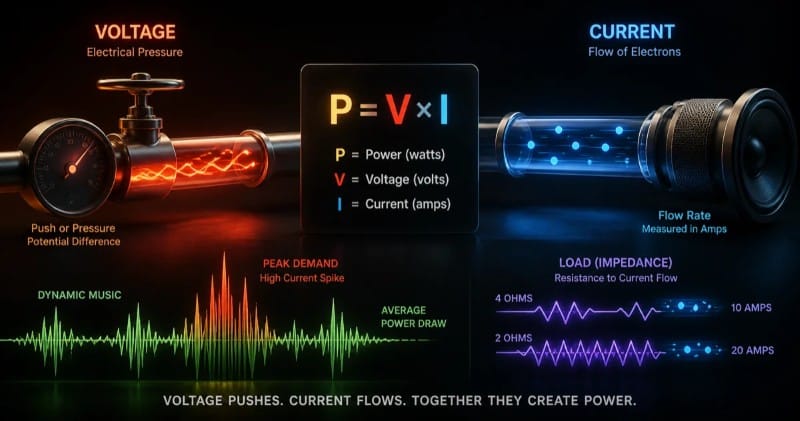
Voltage and current work together to create power through Ohm’s Law (P = V × I), and understanding this relationship is essential for predicting system performance. This fundamental equation shows that power equals voltage multiplied by current.
Consider a 500-watt RMS amplifier operating at 14 volts. Using the power formula rearranged (I = P ÷ V), this amplifier needs approximately 36 amps of current at full output. But that calculation assumes perfect efficiency, which no amplifier achieves. Real-world Class D amplifiers operate at about 75 to 80 percent efficiency, while Class AB designs typically achieve 50 to 60 percent efficiency. So that 500-watt amplifier actually draws 45 to 72 amps from the electrical system, depending on its design.
The relationship becomes more complex when considering impedance. Speakers present a load (measured in ohms) that affects current flow at a given voltage. A 4-ohm subwoofer connected to an amplifier outputting 40 volts will draw 10 amps (I = V ÷ R). Drop that impedance to 2 ohms, and current draw doubles to 20 amps at the same voltage. This explains why amplifier power ratings change with different impedance loads.
Dynamic music adds another layer of complexity. Unlike test tones, music contains peaks and valleys that constantly change power demands. During a bass hit, current draw might spike to five times the average, which is why capacitors and robust wiring become critical for maintaining performance during these transient peaks.
Why Amplifiers Depend on Both Voltage and Current
Amplifiers require stable voltage and sufficient current to produce clean, reliable output. Inside an amplifier, the power supply converts vehicle voltage to higher rail voltages needed for output, typically reaching 50 to 80 volts for high-power models. These rails depend entirely on steady input voltage and current.
When either voltage or current falls short, amplifiers cannot maintain their rated output. Voltage drops cause the amplifier to produce less power, while current starvation triggers protection circuits that limit output or shut down the amplifier entirely. Quality amplifiers include sophisticated power supplies that can compensate for minor variations, but they cannot overcome fundamental electrical limitations.
How Your Vehicle’s Electrical System Supports Audio Performance
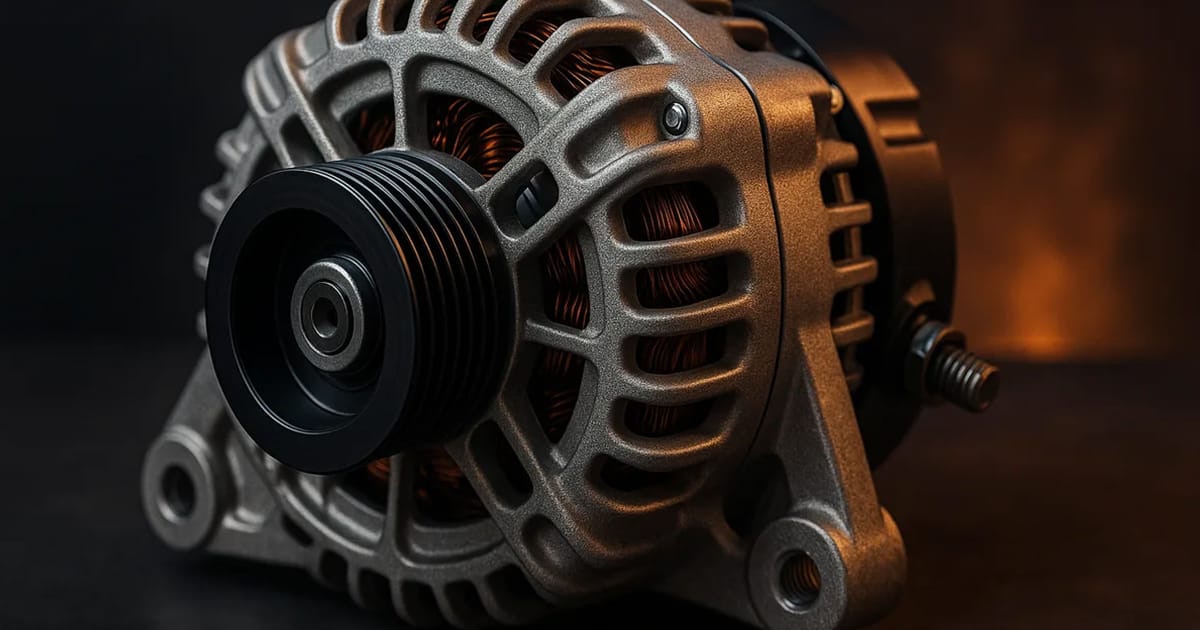
Your vehicle’s battery, alternator, and wiring determine how effectively power is supplied to your audio system. The alternator generates electrical power while the engine runs, typically producing 80 to 250 amps depending on the vehicle. The battery acts as a reservoir, supplying current during peak demands that exceed alternator output.
Factory wiring often becomes the weakest link. A 10-gauge power wire carrying 50 amps over 20 feet loses nearly one volt (assuming copper at 75°F), reducing a 14-volt supply to 13 volts at the amplifier. This 7 percent voltage drop translates directly to reduced power output and potential distortion.
How Electrical Limitations Affect Sound Quality
When voltage drops or current delivery is restricted, your system experiences reduced output, distortion, and inconsistent performance. Headlights dim with bass hits. Amplifier protection lights activate. Bass sounds weak or distorted at higher volumes. Volume levels vary between songs. These problems stem from the electrical system’s inability to maintain stable voltage under load. As current draw increases, voltage naturally drops unless the system has adequate current capacity.
Common Misconceptions About Voltage and Current in Car Audio
Many people assume voltage alone powers a system, but true performance depends on the balance between voltage, current, and impedance load. Higher voltage does not automatically mean more power if current is limited. Adding multiple batteries increases current reserve but does not change system voltage. High-output alternators provide more current capacity but maintain the same charging voltage. Understanding these distinctions helps avoid costly mistakes when upgrading electrical systems.
Ready to design a system that delivers reliable power to your amplifiers? Visit the BestCarAudio.com Dealer Locator to find electrical system experts who can calculate your exact voltage and current requirements for optimal audio performance.

